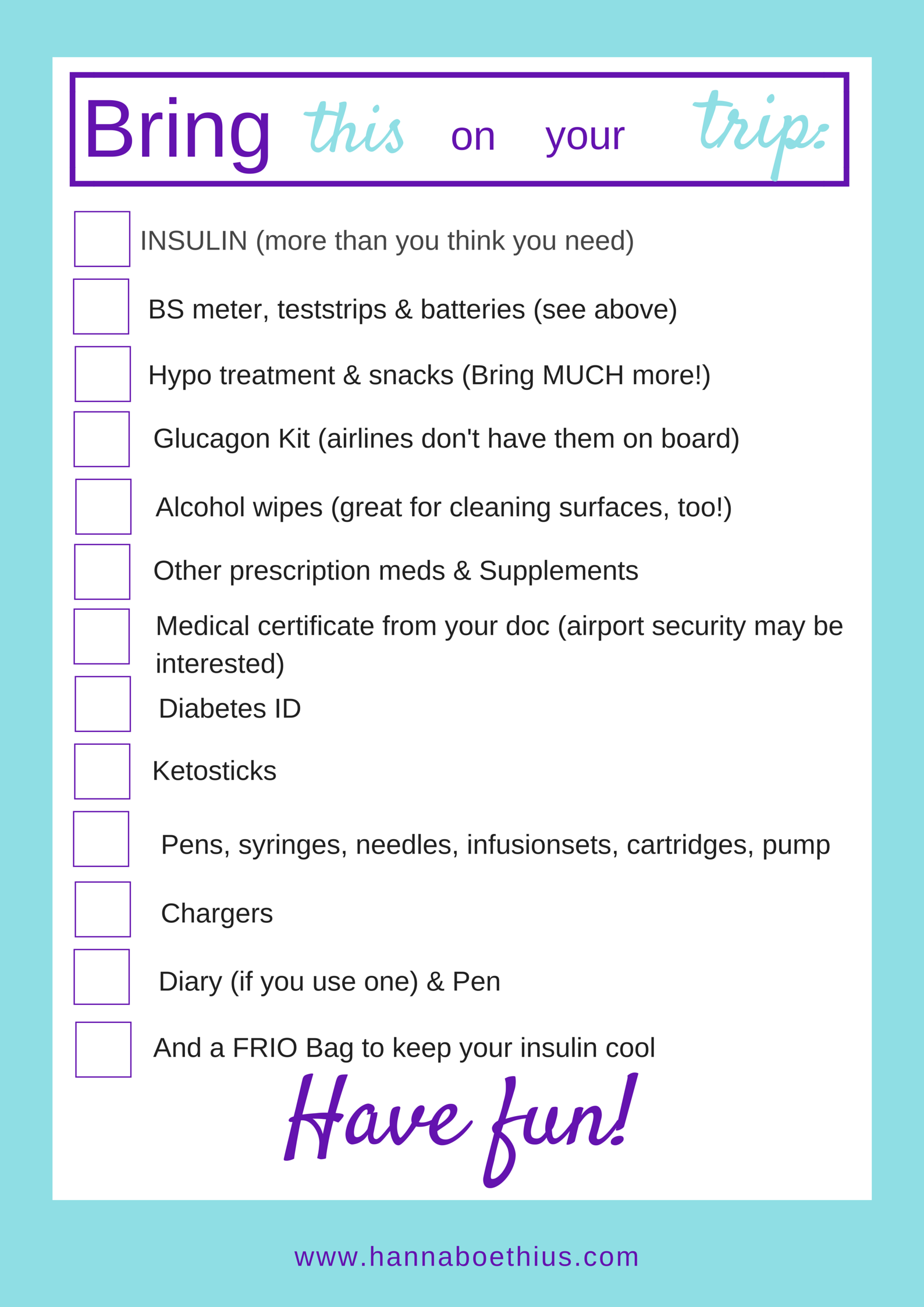
Maybe you’re planning a trip soon and would love a travel checklist for diabetes?
(I made you a travel checklist for diabetes below, make sure to check it out!)
What is necessary to bring along on a long trip with diabetes?
Sometimes I feel like diabetes just has its own luggage to bring along, physically as well as emotionally.
The emotional luggage we’ll have to discuss another time, because this time I want to talk about the physical luggage Diabetes brings along. Especially when traveling.
As if packing for a trip isn’t stressful enough (“what shoes should I bring?”, “does this dress go with that jacket?”, “what make up should I bring?” and “WILL IT ALL FIT IN MY BAG?!” – you get the point…), as an added bonus, you also have to haul around on all the stuff that you need for diabetes to keep in line.
I always bring all my supplies in my carry on bag when I fly. That way it’s harder to lose it, and the insulin stays at the right temperature throughout my trip.
The size of said carry-on bag has changed, though, in favor of trying to save my shoulder from falling off from carrying all the heavy stuff. Now I bring along a small, cabin sized wheelie bag where I have all my supplies, from insulin, to pumps, to test strips, to hypo treatment.
I also deposit a few things in my traveling buddy’s, usually my husband’s, bag. At least that way, if I lose my carry on, I’m not completely stranded in terms of diabetes. He has an extra blood sugar meter and test strips, and insulin with emergency-syringes. And glucose tabs. One can never have enough of those.
While I make sure to bring along most things on my travel checklist for diabetes, I don’t always bring everything.
Like ketone sticks, for example. I don’t usually bring those, unless I’m traveling somewhere really remote with no pharmacy within the next hour or so of driving. I figure that I can buy them pretty much anywhere I go.
On the other hand, insulin and BG test strips can get really darn expensive, not to mention inaccessible without a prescription, unless you prepare properly and take enough with you for your whole trip. “Enough” here means way too much, by the way. You never know what might happen, so it’s better to be prepared for most things that may happen.
Food
And, pretty please, get organized and bring your own snacks. Food on the road is generally beyond terrible, and like that you know you can at least eat something. I bring things like nuts and dried meat and other cutleryless foods on the plane, whilst in a car or on the train you can get a little more creative. This time around I’m going to make low carb pancakes and wrap them up in foil to bring along on my long flight, as I know from experience that food on flights is never good.
Another note regarding food, please don’t get fooled by the “need” to snack, which is most commonly masking the fact that you’re bored out of your brain.
Water
Traveling by plane is like sitting in the middle of the desert, although maybe not quite as warm. It’s dehydrating like nobody’s business! Being hydrated can really be one of the keys to better diabetes management, so please do us both a favor and DRINK A LOT OF WATER! (and skip the booze up in the air, but that one is evident, right?)
Security
Getting through airport security can be a lot easier than it’s made up to be. This is of course assuming that you don’t meet an a-hole security agent.
In my 30 years of living with diabetes, having traveled to many different parts of the world (although I have MUCH left to see and visit!), I’ve been stopped exactly twice at security. Once for my test stripes (what, you didn’t mind the syringe full of potentially very deadly stuff in my bag? Ok, then.) And once because my pump set the alarm off. In both cases it was easy to explain, and I didn’t even have to show my medical certificate. Security agents see so many diabetes supplies on a daily basis; they’re barely phased by them anymore. At least within Europe.
Now, I’ve heard that US TSA agents can be a little trickier to handle. For example, they have no problem jeopardizing your super expensive medical equipment and tell you to go through the full body scanner wearing your insulin pump, for example. I would insist on the pat down, not risking any breakages or malfunctions. This of course means that it might take a little longer for you to get through, but it’s worth it, and as long as you know about it, you can plan for it.
The bottom line is, as long as you’re nice and cooperative (enough) to them, they’ll usually treat you with the same respect.
Anyway, let’s check out the goodie in this blog post, my Travel Checklist for Diabetes.
These are the absolute essentials that you need to bring with you (or at least consider bringing with you). If you think “I’ve never needed that before”, you should probably take it along anyway, as traveling can make your body do some funky stuff.
Travel checklist
- Enough insulin to cover the days you’re gone (this should be a no brainer!) Make sure you bring both basal and bolus insulin, even if you’re using an insulin pump. You just never know…
- Blood glucose meter & enough test strips, extra batteries (it might even be good to bring an extra BG meter.)
- CGM sensors
- Keto sticks (As I said, I don’t always bring them)
- Glucose tabs (or whatever you use to treat a hypo) (Bring too much of this, you never know what your body think of your new location.)
- (See above)
- Glucagon Kit (most airlines don’t have these on board their planes. Better be safe than sorry!)
- Alcohol wipes (these are great, not just for setting infusion sets and cleaning fingers, but also for wiping surfaces like tables, handles or cutlery that seems unclean.)
- Other prescription medication and supplements you may be taking (easy one to forget, trust me. I’ve done it before.)
- If you’re going somewhere really warm (lucky you!), bring something like the FRIO bag to keep your insulin in. (http://www.frioinsulincoolingcase.com)
- Medical Certificate (This can save you at security checks!)
- Diabetes ID (If you’re found unconscious somewhere, I’m sure you’d prefer that the EMTs knows what you’ve got.)
- If you’re going somewhere remote, bring a glucagon set. (Again, you never know.)
- Your BG diary, if you use one. (Otherwise there’s some great apps for that, for example www.glucosebuddy.com or mysugr.com)
- Address and telephone number of your doctor’s office.
If you are on injections, also bring:
- Insulin pens, plus back ups
- Pen needles
If you’re on a pump, also bring:
- Your pump, as well as possibly getting a back-up pump. (This can be ordered from your pump manufacturer.)
- Batteries/Power adapter
- Cartridges (if your pump uses those)
- Infusion sets, or just enough of patch pumps
- Syringes/pen for emergencies
- Basal insulin for emergencies
If you’re planning a pumpcation (vacation without your pump):
- Your action plan, that you’ve talked to your med-team about
- Pens and needles
- Basal and bolus insulin
It’s better to take too much than too little!
I’ve made a pretty print out of this list that you can print out and tick off the boxes as you put the items into your bag.
This blog was originally published on Hanna’s website at http://hannaboethius.com/2015/05/travel-checklist-for-diabetes/.
The date was February 1st, 2014, a date my husband and I will never forget. I had given birth to our fourth child just four months earlier. We thought it was a healthy pregnancy, despite regular contractions around 25 weeks on. We were on the twelfth hour of being at the hospital, originally checking into the ER as my regular OBGYN advised. Then we moved up to the fourth floor, Labor & Delivery. As I lay on the half bed, my husband watched as I began a never-ending massive hemorrhage — so much, that I nearly lost consciousness. I remember my sight becoming blurred as my hearing faded in and out. The RN ordered a large bucket, then two more to catch the excessively large clots, while still insisting that it was just a “heavy menstrual period.” But uncertainty lay on her face. It indeed was not, and I refused to be discharged to go home and bleed to death.
After earlier tests in the ER and on the second floor, all the doctors and nurses still reassured me I was either miscarrying or newly pregnant. They wanted to discharge me. I refused each time, because deep down I knew there was something wrong. The day prior, my OBGYN did a vaginal ultrasound and we saw the grape-like image on the screen. Something was there.
After I was given oxygen and laid with my head lower than my feet, I was able to regain full consciousness and sit up. It was then another floor doctor had come in and ordered labs for a b-hcg draw. Within 30 minutes, we were facing four various doctors, telling us I had choriocarcinoma from a complete twin molar pregnancy that resulted from our newborn’s undeveloped twin.
What? I only briefly knew of this rare, placental cancer from the book, “What to Expect When You’re Expecting.”
I was admitted late that night after I tried to breastfeed my baby one last time. The rest of the night until early morning consisted of tests, from a CT scan, to an MRI, to a florescent contract glow agent CT. I was alone and scared.
It was then I was told it hadn’t metastasized to my brain, luckily, but possibly to my right lung. My pregnancy hormone, b-hcg levels were extremely high, over 221,000.
Choriocarcinoma metastasizes from the uterus to the lungs, liver, and finally the brain, very aggressively and fast. It is very responsive to chemotherapy IF caught in time. I was between stage II/III, FIGO Score 6.
A picc-line was inserted the following morning and I was given my first needed blood transfusion in prep for chemo. Everything had happened so fast that it was hard to comprehend it all.
My oncology team believes the choriocarcinoma was fully gestated around 22-27 weeks into my pregnancy, around the same time I began getting regular contractions. The only other symptom was intermittent postpartum bleeding and passing round, flat clots. Other symptoms can include regular pregnancy symptoms, menstrual or pelvic pain, increased or high b-hcg levels, coughing, shortness of breath, dizziness, blurred vision, headaches and even seizures. I had regular pre-natal care and addressed my OBGYN regularly. And still, nothing was detected with exams until four months after giving full term birth.
Which is why I stress, be your own advocate.
I began weekly Methotrexate chemotherapy February 4th, and after four rounds, learned it wasn’t working, due to resistance. My b-hcg levels weren’t dropping quickly enough. I was then put on aggressive “5 agent chemotherapy” known as EMA/CO. I had week after week of infusions, with a total of 12 total rounds. Going through the treatment was very hard. And there were many times I didn’t think I could continue on, looking death in the face. I was neutropenic most of the time (low or no white cells) and we learned to give Neupogen shots at home in my belly. I had many complications, including needing another blood transfusion, getting a UTI, and being rushed to the ER a few times for fever.
After inpatient chemotherapy, I was instructed to not pass on any bodily fluids, like kissing, especially with my newborn, due to my toxicity levels from the chemotherapy. Most of my days were spent sleeping in bed, snuggling my newborn and listening to the noises slipping by of my children and husband.
What is molar pregnancy and placental cancer (choriocarcinoma)? A molar pregnancy results from the disease gestational trophoblastic neoplasia and not all turn malignant like mine did. Basically, the abnormalities begin at fertilization. In a partial molar, two sperm fertilize one egg, leaving an abnormal fetus that will either naturally abort or have to be terminated. In a complete molar, one sperm fertilizes one egg that has missing DNA/chromosomes, thus stopping at the placental formation causing abnormal placental cells. In my case, I had two eggs fertilized; one being our healthy baby girl and the other a complete mole egg. This type of case is rare, especially with our baby surviving. She will be three years old this September and is still healthy.
One key change I would like to see is more awareness. Since my own diagnosis, I’ve been a strong advocate, raising awareness through Facebook support groups, as well as my own Facebook page, Choriocarcinoma & Molar Pregnancy https://m.facebook.com/choriocarcinomaandmolarpregnancy/ and others to further reach the public.
I realize others have not been so fortunate, and try to help their families in any way by providing support for their loss. I’m in contact daily with hundreds of other women, some new cases, each week.
I also advocate and raise funds for Dr. Goldstein’s exclusive Choriocarcinoma Research Fund at Brigham’s in MA https://giving.brighamandwomens.org/choriocarcinoma
I give credit to my oncology team and Dr. Goldstein’s fast acting, life saving treatment, but most of all, to God for sparing me. It was hard to explain to my children, especially my 4-year-old at the time, that I may die, and why all my bodily hair was gone. He was devastated to see my eyelashes and eyebrows fall out. It’s not the easiest to talk of death to young children.
The anxiety of this journey and being away from my children was just unbearable. I also suffered PTSD and became unknowingly dependent on Lorazepam as a result of using it as pre-chemo meds every week. I am now free from these bondages through faith and prayer. I still have the normal “scan-xiety” and fear when a fellow choriocarcinoma sister has recurrence or loses their fight. I am two years cancer-free now and will ne two years chemo-free this July.
I now live with chemotherapy side effects, such as premature menopause, bone pain, low bone density, neuropathy, chemo brain and vision loss, to name a few. I also suffer from nerve damage from the picc-line.
My advice is to listen to your body, regardless of what a doctor may tell you. A simple home pregnancy test can pick up any detected b-hcg levels.
Be your own advocate, because no one else will.
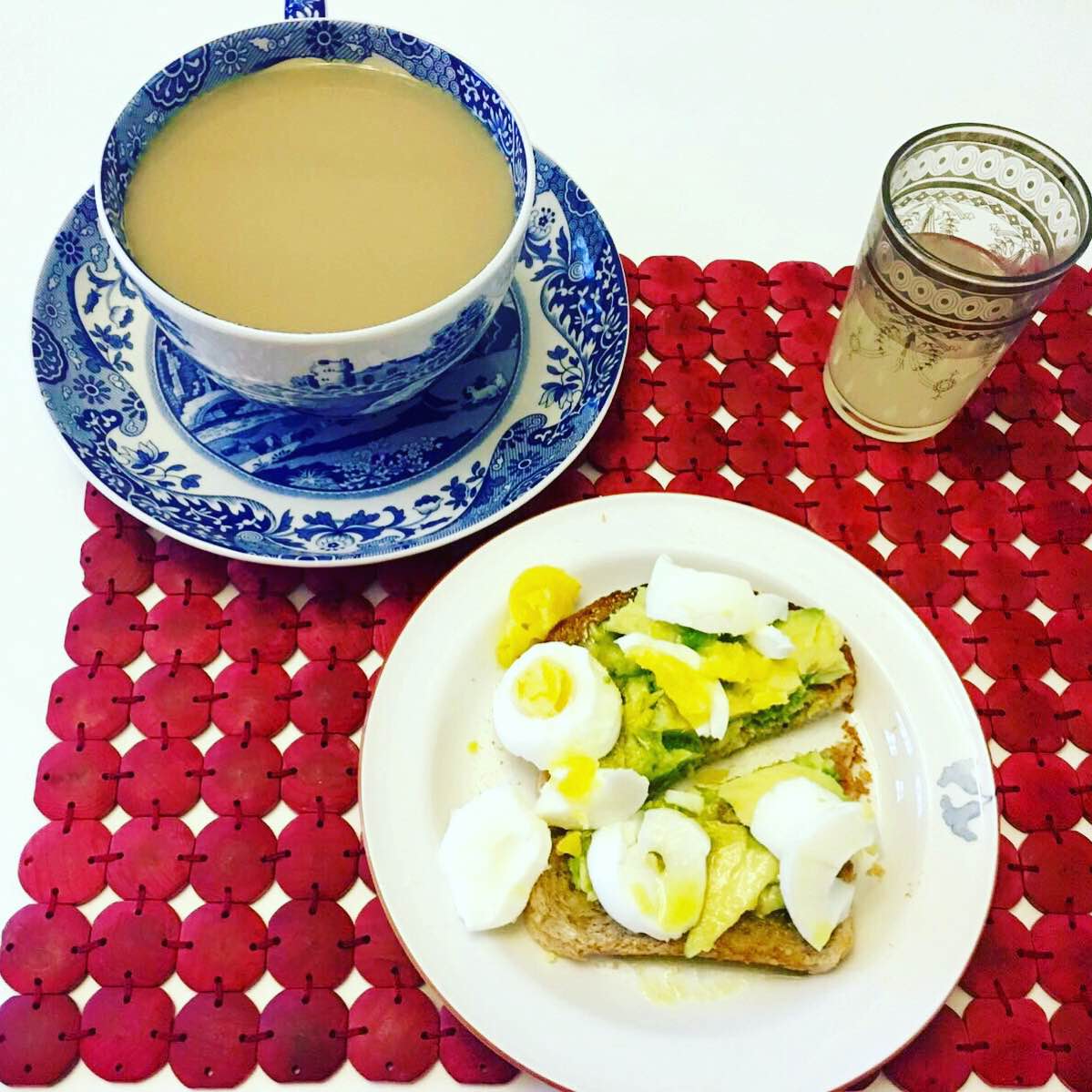
- Boil water – make tea, and add milk
- Pour water in glass, add vitamin c effervescent tablet
- Toast one slice of multigrain bread
- Mash up 1/2 avocado (ripe) and add some sea salt
- Smear avocado on toast
- Divide toast in two triangles
- Slice one hard boiled egg and place slices on avocado toast
- Season with sea salt and add olive oil on top
Enjoy!
What can you create from your cancer experience? Or what can you bring to your life as a result of your cancer experience? The results are endless.
Life is so crazy! If I hadn’t had so many life challenges and wasn’t committed to personal development, I wouldn’t have been able to create nearly as much as I did a result of my cancer experience.
My diagnosis came in 2012. Had that diagnosis come ten or fifteen years before that, I think I would have handled my cancer experience so much differently.
In the past I was this people pleasing perfectionist, who wouldn’t let anyone in and wanted everyone to think that I had the perfect life. So not true, because no one has a perfect life. We never know what goes on behind closed doors until we reveal them to ourselves first.
What I am leading to is if I had had my cancer experience long ago, before I opened up myself to others, realizing that we are all the same, I probably would have hid for about a year or two until I was fully healed. I wouldn’t have asked for help, support or exercised self-love and extreme self-care. I wouldn’t have been able to heal mentally and physically in the way that I did in 2012.
Our cancer experience, or any other life experience for that matter, is about opening ourselves up to others and letting them in.
I feel Blessed that at the time I had my cancer diagnosis, I was finally able to be in a place where I was ME. I was myself. I was open and honest and able to expose my vulnerabilities and my deepest truest self.
When I finally swallowed and processed my diagnosis, I was able to reach out to my friends and family and ask for support, reach out to my children’s teachers and ask them to look after my children, talk to my colleagues and tell them to take over for me while I took the time to heal.
By this time in my life I had retrained my brain to weed out all of the false beliefs and chatter that was in my mind, telling myself that I could handle this on my own. Those weren’t my voices, they were the voices of my past.
In opening up myself to others and exposing myself at one of the most vulnerable times of my life, I was able to access love, hope, faith and strength. I stood in awe at all of the love and support that came my way and how I was fully open to receiving it and it helped me created a better me for myself. It allowed me to be open and honest and create sustainable change which had a ripple effect in all areas of my life.
This whole path led me to seizing my dream of helping others help themselves. Shortly after my last surgery I stumbled upon coaching and before I knew it I was in training to become a life coach. Now I have a business called New Beginnings Coaching Services, LLC with a niche in helping survivors and caregivers create New Beginnings in their lives during, through and after cancer.
So I ask you now. What can you create from your cancer experience? What are you hiding from or holding the door closed on? What is blocking you from letting others in? What would it feel like to give up control and let others in?
I could go on and on with the questions. The bottom line is that being open and real allows so much to come into your life. It creates a sense of peace and freedom.
If you are struggling to find your Who and how you can open yourself to letting others in, reach out to me so that we can work in partnership to creating “the more” in yourself and in your life that you have always been yearning for. You already have the answers, you just need a facilitator to help you create awareness and action steps toward your goals.
Visit my website www.newbeginningswithgina.com or email me at gina@newbeginningswithgina.com.
Race Report: Folsom Triathlons
June 13, 2016
Race: Folsom Triathlons
Distance: Sprint
Location: Lake Natoma, Folsom CA
Date: 06/05/2016
“Courage isn’t having the strength to go on – it is going on when you don’t have strength.” – Napoléon Bonaparte
I knew RA, (Rheumatoid Arthritis), had plans to reap havoc on my body the night before my race when I went to stand up from the sitting position and pain in my right knee almost had me laid out on the floor. Pain all night in my knee and in my hips poured into race morning. RA was like “Oh you’re racing today? That’s cute.”
Hence the hardest part sometimes about being a triathlete with RA – no matter how hard I train, or how prepared I am going into race day, it can all be derailed in seconds without reason or warning. When this happens I have two options: 1. Don’t race, or 2. Don’t let the disease detour me from chasing my dreams.
Because I’m headstrong, I usually choose the later. (Through 13 years of battling RA, I’ve learned what I can push through and what I cannot. However, I can only use my best judgment – again the disease is completely unpredictable and I must suffer the consequences regardless.)
This race held lots of firsts for me: first race of the season, first one post total wrist fusion, first one racing my sponsored bike, and first race having a coach. This triathlon season I’ve been working harder than ever before, and was stoked to start racing.
At the same time, I was also extremely nervous. All the normal race nerves, but I was mostly nervous about my new wrist in the swim leg. Any triathlete would understand why – it can be violent in the water. Getting kicked, hit, and even swam over is a normal occurrence in triathlon. If I were to take a hard enough hit to my wrist in the swim, it could’ve forced me to pull out of the race or even worse break my wrist.
 Training details leading up to race day:
My main event is Olympic distance triathlons, so my training thus far has been focused mainly around Olympic. I’m usually training 6 days a week, (with a couple of those days having two workouts on the same day), and one rest day per week. As a triathlete with RA and many other chronic pain conditions, I sometimes require additional rest days and also changing scheduled workouts to adapt to how my body is feeling on any given day. This is a constant struggle which results in me feeling like I’m not able to train at my “full” potential.
Nutrition leading up to race day and on race day:
As far as day to day nutrition goes, I eat to help treat symptoms and to help control my disease. For me, this means lots of whole, natural, real foods: veggies, fruits, chicken, fish, nuts, whole grains, etc. This diet matches up nicely with a triathletes diet/ nutrition needs. Win- win! When it comes to nutritional supplements for training and racing, my trusted favorite is Hammer Nutrition products. The regulars in my regime are: premium insurance caps, mito caps, tissue rejuvenator, race caps supreme, endurolytes, heed, recoverite, and hammer gel.
Race day:
Woke up earlier than normal to give myself enough time to ice my flaring knee and use my tens unit before leaving the house. Arrived at the race venue shortly after transition area opened and hobbled around setting up my gear and bike before the rush of triathletes. Then found a bench that I could put my leg up and ice my knee/hips. Got to ice a couple of times before getting my wetsuit on.
Decided that it would be wise of me to get in the water much earlier than my wave start for two reasons: 1.So that I could see how it felt to swim with my wrist brace on (I hadn’t swam with it before, and wearing it was the only way I could help protect it), and 2. Let my body get accumulated to the cold temperature to avoid lower back cramping and spasms (my body doesn’t play nice with cold water. See my Nationals race report).
Started the swim towards the back of the pack and to the outside, but I still took some kicks to my wrist. They hurt, but not enough to pull me out of the race. It was enough though to slow me down out of fear. I was scared the entire swim, which forced me to swim very cautiously and slowly. Swimming isn’t my strong suit anyway, so I tried not to let it upset me too much and focused on playing catch up on the bike.
In T1 I struggled trying to get my wrist brace off so I could get the wetsuit off. Then I had to put the brace back on for the bike leg, just in case of a crash or fall (plus I promised my Ortho surgeon I would). The bike mount area was a mad house – way too small of a space for the number of people racing and it was on an incline which made it a total recipe for disaster. Again, I was scared that I would crash right there and hurt my wrist so I waited for a clearing so that I could take off as safely as possible.
By the way, I had started my Garmin as a swim instead of in multisport mode and I didn’t realize it until after the race. So when I got going at a good pace on the bike, I started to scroll through my watch looking for my pace but none of the stats were making sense. I had no clue what my speed was, how much time had elapsed, or what mile I was on. My knee was hurting but overall I was feeling pretty strong one the bike, so I tried to pace off of how I felt. I ended up asking someone what mile we were on about half way in. Towards the last couple miles I started recognizing the course and knew I was almost done. I sped up trying to empty the tank, but when I got off the bike I felt like I could’ve gone harder.
 Running has always been my strong suit, at least it had been until this race. As soon as I started out on the run course the impact killed my flaring knee and hips. The heat also started to hit me. Very quickly I started to realize all the things I did wrong leading up to the run. For starters, I took my pain meds before the race for my knee and hips – I never do this. I didn’t hydrate enough to account for the pain meds being in my system. On the bike, I forgot to take my electrolytes plus I didn’t drink enough water.
I believe the combination of these things played a role in causing me to get heat exhaustion on the run leg. The pain was slowing me down significantly, but the heat exhaustion brought it to a whole other level of suck. I remember getting the chills and then goosebumps – shortly after that I threw up. The rest of the run I felt nauseous, disoriented, and sharp pains in my knee and hips each time my feet struck the ground.
Once I crossed the finish line I hobbled straight to the med tent where I tried to regulate my body temperature, hydrate, and ice my pained joints. I was so disappointed in my run, but was relieved that I finished. After such a grueling experience, I was thinking that I’d be lucky to break top 5 in my AG. My boyfriend and I were just about to pack up to go home when they posted printed results. Out of curiosity I checked, and was shocked to see that I placed 2nd in my AG!
Podium? How did that happen?! Missed 1st by 2 mins, and also missed a qualifying spot for USA Triathlon Nationals. That was a bummer for me because my run was what caused me to miss 1st. Hard pill to swallow because I’ve never had such a horrible run before (for some perspective, I run faster in training runs). Aside from the run, I managed to clock my fastest bike split I’ve ever had – which landed me at the fastest split in my AG. Overall (OAF), I ranked 15th in my division.
None of this would have been possible without my amazing coach Stephanie Artis who pushes me outside of my comfort zone, and my incredible sponsors: Hammer Nutrition, Rudy Project, Love The Pain, Kinetic Cycles, Pearl Izumi, and Team Freeplay – thank you all for believing in me. Can’t wait for the next one!
 Dina Neils – Titanium Triathlete
CreakyJoints SpokesAthlete
W: dinaneils.com
E: dina.rawarrior@gmail.com
IG: @titaniumtriathlete
FB: facebook.com/titaniumtriathlete
Twitter: @titaniumtri
It’s something that always goes together. It’s something with many factors. It’s something that you never get a break from. It’s also something that isn’t often talked about or factored into everyday care. It’s splattered with stigma, stereotypes, shame, and silence. Well, it’s actually two somethings. It’s type 1 diabetes and mental health.
Type 1 diabetes and mental health very often impact each other one way or another. Type 1 diabetes and mental health impact everyday life, but everyday life also impacts the two. You can never take a vacation from type 1 diabetes and mental health. It’s a rare event when mental health is factored into diabetes care. You see the stigma, stereotypes, and silence around type 1 diabetes and mental health constantly, but it’s also accompanied with silence and shame.
This all very much so applied to me for the majority of my life doubled with the fact that in my mind I could only be positive about type 1 diabetes and the fact that I had had few good experiences with counseling. In my mind, I was invincible ever since I was diagnosed at 7.
But soon that all changed- compounded with many years of living with type 1 diabetes, my studies in Social Work in college, my involvement in the diabetes community online and in life, hiding from the past and things I didn’t want to deal with, and the fact that I was going a million miles an hour with limited self-care.
Diabetes Burnout hit me with full force my junior year of college. I had faced a wall that for the first time I couldn’t climb over or burst may way through. My Diabetes Burnout lasted for months and under a cloak of silence and shame. I searched for information- I found some resources that didn’t seem a right fit for me, and I found almost no “me too’s.” I did however discover how wonderful and beneficial counseling was.
I came out of it eventually, but I was very different when I did. My thoughts on mental health were the biggest change for me. Self-care immediately became a regular part of my routine. I yearned for more me too’s, and eventually I made it my goal to be more honest not just to myself, but to the outside world about mental health, but especially mental health and diabetes.
My senior year of college came, and towards the end of the year so did a triple diagnosis of ADHD, Anxiety, and OCD. All of which apparently presented before the age of 12, but it was missed duee to the focus on diabetes and my mistrust of healthcare providers.
So again- something changed. With that change, so did my blog.
I’ve shared versions and bits of this story before in print and in person. Especially because only a few people probably wear their mental health on their sleeve.
But I hope for things to change. I hope for a diabetes community that doesn’t call burnout giving up. I hope for more research. I hope for a day that mental health isn’t a joke, that diabetes isn’t a joke, and especially that the two together are not part of jokes.
The truth of the matter is that I live with type 1 diabetes, ADHD, OCD, and Anxiety, but that is just a part of who I am. But these parts are very much together with other aspects of my life.
I have to check my blog sugar and give insulin many times during the day, and battle the OCD that begins to obsess over my continuous glucose monitor. I’m figuring out how to navigate ADHD and anxiety in the workplace. I’m still learning my triggers and figuring out what works for me.
And to be perfectly honest, this is mostly for me- a part of my self-care- I am not great at verbalizing how I feel- especially if those emotions aren’t positive, but I can do it through writing.
But I can’t lie when I hear or see someone say “me too” or I thought I was the only one- because it’s a nice reminder to keep doing what I’m doing, but it’s also a reminder that I am not alone.
Social information-
Instagram and twitter: @mindy_bartleson
Blog: https://mindydiabetes.wordpress.com/
Facebook Page: https://www.facebook.com/theresmoretothestory/
We know there are several different gene variants that indicate Sickle Cell Disease, (SCD) which is characterized by the abnormal hemoglobin (the protein of the Red Blood Cell); HbSS, HbSC, HbS beta thalassemia, HbSD, HbSE, HbSO, and of course you have the Sickle Cell Trait (SCT) or HbAS. What we don’t know is; why is there so much variation in the experiences of SCD related symptoms at the individual level of SCD patients? Why are some individuals constantly in pain while others rarely experience it? Why do some people die while others live? Why do we hear so many stories, from people who have SCT, who have experienced symptoms similar to that of a person who lives with SCD? Especially those horror stories of folks who pass from sudden death related to overexertion. Could these incidents have been prevented? Does everyone with SCT need to be cautious with intense physical activity? What’s the probability that this could occur to them? All questions that I have yet to see a science-based documented answer. I feel like theirs so much unknown about these many different hemoglobin gene variants. These unanswered questions are what has driven me (and I mean that literally) to learn and participate in such initiatives like Precision Medicine, as well as the NEW National Microbiome Initiative (NMI), of which I participated in its announcement on May 13th at The White House.
I was invited alongside my partner Michael Friend as we had been planning to work on a microbiome project utilizing our newly formed sister organizations; the Minority Coalition for Precision Medicine (MCPM) and the Health Ministries Network (HMN), divisions of our marketing company; Future Marketing Group LLC. Prior to this exciting event, my partner and I flew out to Chicago where at the University of Chicago we met up with our colleagues; Martha Carlin, a revolutionary Citizen Scientist and CEO of The BioCollective, microbial revolutionary scientist and University of Chicago professor Dr. Jack Gilbert, and several other great minds with the intention of putting our brains together to plan the initiation phase of our then Precision Medicine Initiative related project on Post-Traumatic Stress Disorder (PTSD). I personally was really excited about this project and it’s potential to uncover the susceptibility of children living in inner cities to a pre diagnoses of this common mental health disorder. Although this would’ve been such an important fascinating research study to collect data on, I felt compelled to stress how my illness, Sickle Cell Disease (SCD), would be a prime candidate for personalized medicine related study. I even tried to argue how they could use photos of myself to make SCD look “sexy” enough for the White House to even be interested in highlighting such a commitment in a press release. Dr. Gilbert’s heard me ramble of my interest in constructing such a project before, but this time he gave in (caught him on a good day lol). He informed us that he was working on a microbiome project and that we may have an opportunity to form this project under that in a collaborative effort. Martha gave me a look like “wow Shakir you did it!”, I was just SO EXCITED! About a month later our vision became a reality as the White House outlined the scope of our project on pg.18 of their fact sheet during their launch of the National Microbiome Initiative (NMI). In our particular study we will be collecting stool samples from individuals who have sickle cell disease as well as folks who have sickle cell trait. Approximately 500 each. We have an opportunity to collect data, at the microbial level, from the rather underserved sickle cell community throughout the United States. An opportunity to determine how our microbial surroundings are affecting our susceptibility of experiencing sickle cell related symptoms such as; pain, fatigue, ischemic stroke, acute chest syndrome, etc. We can do comparative analysis of the differences in the affects that having a non-diverse gut microbiome has vs having a more diverse gut microbiome and it’s impact on the behavior of the disease. Most importantly, this study will ultimately provide a better understanding of the difference in the genotypes that characterize sickle cell and aid in the development of new treatments, possibly even the development of a less risky cure. As Co-Founder of the Minority Coalition for Precision Medicine (MCPM) I am proud to be launching this project, as one of the catalysts of the White House National Microbiome Initiative, on June 19th in celebration of World Sickle Cell Day! On that day, please visit GoSickle.com to get involved and to be one of these first participants of our microbiome study!
Here The BioCollective’s CEO Martha Carlin speak about the project in a recent interview on a Colorado NPR program called “Colorado Matters”, listen here.
http://bloodbornsicklecellactivist.blogspot.com/2016/05/explorations-into-microbiome-of.html
No water, no life. No blue, no green.
-Sylvia Earle
Bathing has long been said to be good for our physical health. A study in the New England Journal of Medicine showed that diabetes patients who spent thirty minutes in a tub of warm water lowered their blood sugar almost thirteen percent. Japanese research revealed that a ten-minute soak can improve the health of men and women. Bathing is good for the immune system and it decreases stress.
There’s a long history of using bathing medicinally. The term “balneotherapy” relates to spa treatment, hot baths and natural vapor baths. Resorts add minerals or essential oils to naturally-occurring hot springs. Balneotherapy is used for illnesses like arthritis, skin conditions and fibromyalgia. The term “hydrotherapy” is a part of medicine that uses water for pain relief and treatment. It uses the temperature and pressure of water therapeutically, to stimulate blood circulation and treat symptoms. Hydrotherapy often includes water jets, underwater massage and mineral baths or jacuzzis.
Four years ago I was diagnosed with Stage 2 Triple negative breast cancer and I had to go through a lumpectomy, chemotherapy and radiation for 8 months. This was a challenging period and it brought a few things into clear focus for me: my self-care, my need for continued relaxation and a newfound desire to connect daily to Spirit. This was challenging as a busy psychologist and mother of two kids under 4 at the time. At first I could not take hot baths after radiation but after I started to recover, I was able to take regular baths again.
I found that the one place that my husband and kids left me alone, was in the bathroom. I was able to train them to give me 25 minutes of silence in there. This became my, ‘me time’ to integrate visualization, prayer, meditation and more. I developed this daily ritual and came to call it sacred bathing. This was a regular healing time and dream time.
Today most of us are under chronic stress, especially those of us with chronic illness. It is so important to take this time out for yourself. A sacred bath is your spiritual and emotional hygiene.
To create a sacred bath, clear your bathroom of extra clutter, light a candle, put in some Epsom salts, essential oils and an appropriate crystal into your bath water. You call in Spirit (whether that’s your Higher Self, God, the Goddess or your angels) to receive guidance while in the sacred waters. Then you make a prayer and state your intention. You relax in silence, do a specific meditation around your intention and listen for guidance. Afterwards, you journal about any inspiration you receive. This normally takes 25 minutes.
Below are 7 ways that taking a sacred bath can help you when you are experiencing chronic illness:
- It Connects You to Spirit So that You Feel Supported: When you feel lost or alone it can be helpful to connect to your Spirit and Higher Self. This wise part of you can see the bigger picture. It moves you beyond your ego and limitations so that you reconnect with your essence and remember that your Spirit is stronger than your body. This may not be true for everyone but it was very helpful to me. If I had a difficult surgery it would help me to know that my angels were with me. You can regularly connect to your Divine team through meditation and prayer.
- It Helps You to Be Present: Your sacred bath is a place to just be. In this sacred space you leave the past and future behind. You don’t have to think about that next doctor’s appointment or procedure. You can just relax, luxuriate in the essential oils and Epsom salt and surrender to the moment. When you practice this regularly in your sacred baths it can carry over as a reminder to be really present in each moment, outside the bath too.
- It Shifts You from Fear into Love: When you have chronic illness you can spend a lot of time in fear. When I was undergoing a lumpectomy surgery, chemo and radiation I was often concerned about getting an infection, being tired or in pain. Each procedure had a variety of complications. I knew that it wasn’t good for my immune system and mental health to spend a lot of time in worry. So, taking a sacred bath can be a time to wash all that fear down the drain and focus on soaking up the unconditional love of Spirit. You can use that time to focus on all the love in your life and what you are grateful for. Again, this practice can later be carried over into your days as well.
- It Shifts You Into Your Healing Nervous System: Often we handle stressors while in our Sympathetic nervous system, which handles “fight or flight.” We prepare for defense, followed by exhaustion. In contrast, our Parasympathetic nervous system rebuilds our body, stimulates digestion and aids physical and emotional healing. We enter this nervous system when we relax, like when we take a sacred bath. We can practice making this shift regularly in our sacred bath and then notice which nervous system we are in during our daily lives as well.
- It Washes Away Limiting Beliefs, Centering You in A Positive Frame of Mind: We all have fears, limiting beliefs and moods that stop us. In a sacred bath you picture all that negativity going down the drain, so that you’re only soaking up love around your intention. This energetic shift often leaves you feeling peaceful and inspired. This allows you to feel more hopeful instead of focusing on what might go wrong.
- It Connects You to Your Body: When we are going through chronic illness often we feel angry at our bodies for inconveniencing us and causing us pain. We may feel disconnected from our bodies and feel like doctors and people are working on them from the outside. But, no one affects our body more than us. Your sacred bath is your time to connect to your body and to ask it what it needs and listen for guidance. Sometimes we don’t make this time to slow down and listen. You can create regular time to hear and meet your body’s requests for more play, sleep, laughter, nature etcetera. You can also picture yourself being healthy, radiant and energetic and anchor those feelings in your body.
- It lets You Experience Pleasure & Relaxation Instead of Pain: Again, when you are chronically ill you may have to undergo surgeries, shots and painful procedures. Sometimes you may generalize this and feel like your whole life is about pain. Taking a sacred bath is pleasurable and sacred time for you to love yourself and your life again. You need to put in time for self-care, for dreaming positive things about your future and to look forward to on a regular basis.
I hope this process that has helped me will also be helpful to you. Remember that you are the hero/heroine of your story so you need to take good care of yourself and keep moving forward.
My Best in Love,
Paulette
I have been labeled a “professional patient” before by friends and family. “PP” for short. Inappropriate humor fans, have at it. While this mostly accurate term is not the initial impression I want people to have, if the shoe fits.
Like it or not, the “PP” title has followed me for 13 years now. You may be asking how or why it was bestowed upon me. The short version? I have a pesky and mysterious autoimmune disease called Lupus. The long version? Well, it seems I also have nine lives. While walking to my car years ago, a drunk driver hit me and ran me over (not my best day!). This triggered the Lupus to reveal itself. Since my diagnosis, there has been a flurry of mini-strokes, a small brain aneurysm and blood clots. Throw in some heart issues, chemo and an occasional wheelchair for good measure, and you have my semi-condensed medical history.
These events happened at a young age and I had no choice but figure out how to navigate our country’s health care system and manage a chronic illness, all while attempting to lead a “normal life.” This was especially difficult in my 20s. I was clueless as to how one lives with an incurable illness and felt the medical community did not take me seriously because I was young (and looked even younger).
If you live with a chronic disease, you may be able to relate to me. You likely have a roster of physicians you see regularly, hospital experiences which have taught you a thing or two (or fifty), a small home pharmacy (who says we aren’t ready for the zombie apocalypse?), and an unending desire to get the best health care possible.Everyone wants to feel good. After all, it’s hard to check off our bucket list and accomplish life goals if we can’t get ourselves out of bed. So how can we obtain our best health and health care when battling a chronic and/or incurable illness?
I believe we can make further strides on our “best health care” journey when we feel empowered as a patient. Over the years, a variety of ways to deal with a chronic illness has been compiled in my mental Rolodex. In addition to learning how to be flexible and arming myself with a quirky sense of humor, I’ve also created a list of my favorite patient empowerment tips. These are shared below with the hope that you will receive better health care and improved health outcomes. I have even turned them into a snazzy, easy to remember acronym for you: HEALING. I hope they help you on your journey.
HEALING:
H — H is for health summary. This is vital and you should consider drafting one. Using a Word or Excel document, list your conditions, medicines, doctors, past interventions, outcomes, etc. This will come in handy when you have a new physician appointment, go to the hospital, or if you are unable to speak for yourself and medical specialists need to know your history (let friends or family members know where to find the document).
E — E is for expert. Become an expert in yourself! Research your condition/disease, medication and alternative therapies, and any clinical studies that may be taking place. You may be surprised at how confident you become when discussing your illness with others, once armed with the facts.
A — Accept support. Whether it is a spouse, family, friends or a caregiver, if someone is offering you support, please take it. Something as simple as a friend picking up your groceries, or driving you to a medical appointment, can help reduce stress. If you are in need of support, try searching online for local support groups in your neighborhood. This can be a great way to meet others who are experiencing similar challenges and situations.
L — Look for a second opinion (and do not feel guilty about it). If you are being told you have a disease or illness, you have every right to get a second opinion. By doing so, you may learn of additional treatment options or therapies that were not discussed by the first physician. Prepare well thought-out questions for the medical provider and have it organized and written down so you do not forget anything during your visit.
I — Involve yourself. Most physicians I have spoken to or interviewed in the past state they appreciate patients who work with them and take an active role in their own health care.
N — N is for “Saying no.” Do not be afraid to speak up if something does not seem or feel right. We have instincts for a reason.
G — Give thanks to outstanding medical providers. A simple “Thank you” can make all the difference to your physician and health care staff members. They do not have an easy job. If you have a physician who goes the extra mile to help you, let them know how much he/she is appreciated.
Follow Marisa Zeppieri-Caruana on Twitter: www.twitter.com/Lupuschickcom
Take a look at Hanna’s first video on behalf of Lyfebulb! She describes her diagnosis with type 1 diabetes, and how she manages the disease today.